 Imagine Neville
In Neville’s teaching, feeling the wish fulfilled concerns inwardly accepting a desired condition. For careful reading and reflection, separate that standpoint from both your current emotion and evidence about what has happened. You do not need to manufacture certainty to use our tools.
Start with the passage, not a required emotion
Feeling Is the Secret, chapter 4, connects feeling with the assumed desired state. Chapter 24 of The Power of Awareness discusses naturalness within the author’s explanation of fulfillment and failure. Read chapter 4; read chapter 24.
Those are descriptions of the teaching. Our practical distinction below does not ask you to reproduce a particular bodily sensation or accept that feeling determines external events.
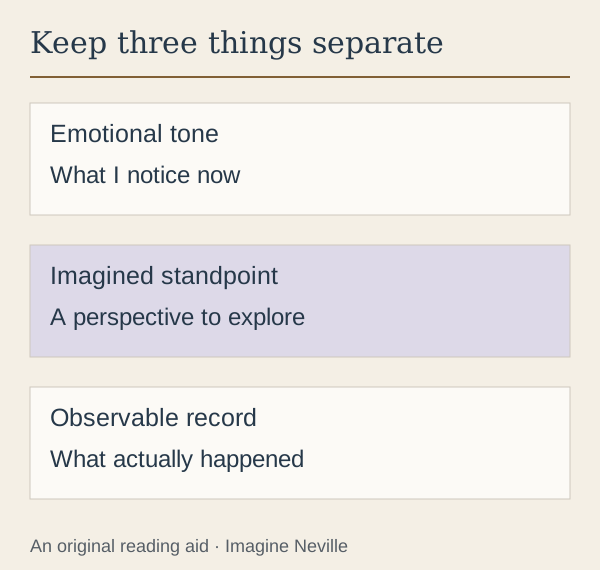
Separate three lines in the notebook
- Emotional tone
- What you notice now: worried, pleased, bored, mixed or difficult to name. No preferred answer is required.
- Imagined standpoint
- The perspective you choose to explore: approaching a task patiently, for example.
- Observable record
- What you did and what occurred. This remains separate from how vivid or convincing the exercise felt.
If you merge these lines, a pleasant feeling can start to look like proof. Or ordinary uncertainty can start to look like a cause of failure. Neither conclusion follows merely from noticing an emotion.
A worked example with mixed feelings
Situation: You need to ask a question in a lesson and feel embarrassed about not understanding.
Emotional tone: “I feel uneasy and a little curious.”
Imagined standpoint: “I can be a learner who asks clearly.”
Scene: “I point to the line in my notes and ask which step comes next.”
Action: Write the question before the lesson.
Later observation: “I asked. The explanation helped with one part, and I still need to practice another.”
This is a complete record. Uneasiness did not prevent the action, and partial understanding did not invalidate the session. The example is ours, not a reported result or evidence for a metaphysical law.
Make naturalness a reading question, not a score
When the author assigns importance to naturalness, ask how the text defines it and how the explanation handles a result that does not occur. Do not assume you can infer someone else’s inner condition from their circumstances.
For your own optional exercise, you can replace a demand such as “I must feel certain” with a task such as “I can write one clear question while uncertain.” This is our adaptation, not a claim that we have found the secret interpretation that guarantees results. The book workshop shows how to inspect a failure explanation without turning it into self-blame.
If words are more useful than pictures
Write a plain sentence describing your participation. There is no need to add an image, a sigh of relief or an imagined voice. A sentence can be a complete prompt for the modest purpose of this exercise.
Use the nonvisual practice page to choose between a written description, an optional inner phrase and a conceptual outline. Use the scene-editing workshop if the draft has become a long movie about everyone else’s reaction.
A reusable three-line check
- Right now I notice…
- The standpoint I want to explore is…
- The action or event I can later record is…
Put the first two lines in your working note. Add the third only when you have an observation to report; do not fill it in as though the hoped-for event already happened.
The Scene Builder can hold the imagined moment, and the journal can hold the later record. For textual context rather than another exercise, return to the Feeling Is the Secret reading workshop.
Sources & reading notes
Sources consulted November 5, 2026. Original commentary; short paraphrases with attribution. No complete works are reproduced here.
- Neville Goddard, Feeling Is the Secret. Chapters 1–4; third-party transcription, compared by chapter heading. Archive rights claims are not a global license.
- Neville Goddard, The Power of Awareness. Chapters 1–3, 6, 21 and 23–24. Third-party book transcription; distinguish it from the 1953 lecture of the same name.