 Imagine Neville
A first-person scene describes a moment from where you would be, rather than watching a movie of yourself. For this site’s optional exercise, keep one ordinary moment, your own participation and a practical next action. The examples below are original adaptations, not historical instructions.
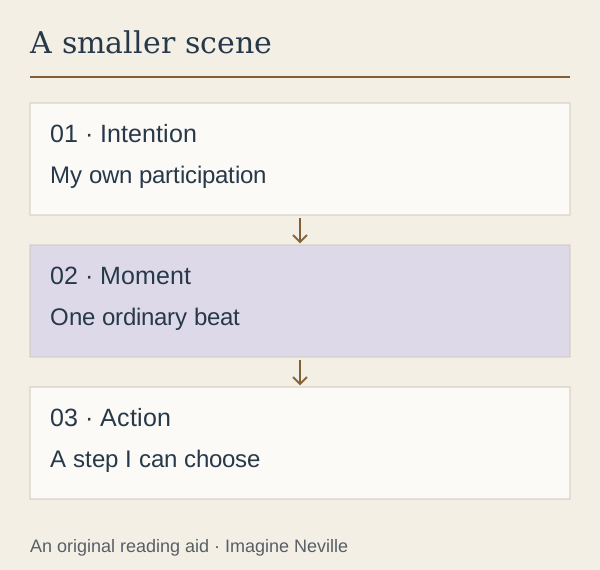
Choose the job of the scene
Neville describes participating inwardly in a desired situation in Out of This World, chapter 1. Read the source context.
Our exercise has a narrower job: prepare or reflect on your own participation. It is not a method for guaranteeing a result. Before writing, name an ordinary task such as starting a draft, asking a question or listening without interrupting. The SATS guide explains the broader practice context.
Edit an observer’s movie into a moment
Draft A: “I see myself walking onto a stage while everyone cheers and the camera moves around the room.”
Three things make this difficult to use as a small personal rehearsal: an outside camera, a long sequence and an audience response you cannot choose.
Draft B: “My notes rest on the lectern. I hear myself say the opening sentence, then pause before the next one.”
The second version specifies a viewpoint and a manageable action. It does not announce that the speech went perfectly. Nor is the shorter draft automatically better for everyone; it simply matches this exercise’s limited purpose.
Use a four-part scene card
- Intention: What part of my participation matters?
- Moment: What happens in one brief beat?
- Detail: What word, sound or sensation would make the description understandable? Optional.
- Action: What can I actually do after writing?
Use the Scene Builder to keep these parts separate. You can leave sensory detail blank. If a picture does not come readily, the nonvisual alternatives offer a written or conceptual route.
Three distinct examples
Beginning a piece of writing
Moment: “I put one rough sentence below the heading.” Detail: the words on the page, without imagining their appearance vividly. Action: open the document and draft that sentence. The scene is useful as a prompt even if the first sentence needs revision.
Listening during a disagreement
Moment: “I wait for the other person to finish, then ask what they mean by the deadline.” Action: ask whether they are willing to discuss it. They remain free to decline. Read the consent decision guide before building a scene around a specific person.
Returning to a learning task
Moment: “I point to the step I do not understand and write one question beside it.” Action: bring the question to the next lesson. This does not pretend that you already possess a qualification or have solved the exercise.
A revision checklist
- Can I describe the viewpoint without a camera outside me?
- Is there one moment instead of a life montage?
- Have I removed guarantees about another person’s response?
- Can I name an action without waiting for a sign?
- Can I stop without treating the scene as unfinished work I owe?
There is no required number of seconds, repetitions or details in this adaptation. Shorten the description until it is usable; do not make brevity into another performance test.
After trying it, record a separate observation
Write what you actually did and what happened afterward. “I opened the document and wrote three rough lines” is a record. “The scene arranged my success” is an interpretation that needs further support.
If the task still felt difficult, keep that fact. You can change the scene, change the practical plan or stop using the exercise. For backward-looking examples, use the revision notebook workshop, where factual and imagined versions remain visibly separate.
Sources & reading notes
Sources consulted November 5, 2026. Original commentary; short paraphrases with attribution. No complete works are reproduced here.
- Neville Goddard, Out of This World. Chapter 1, “Thinking Fourth-Dimensionally.” Third-party transcription.