 Imagine Neville
This is a workshop to use beside Feeling Is the Secret, not a substitute for it. Read the original chapter, identify the kind of claim being made and keep your response on a separate page.
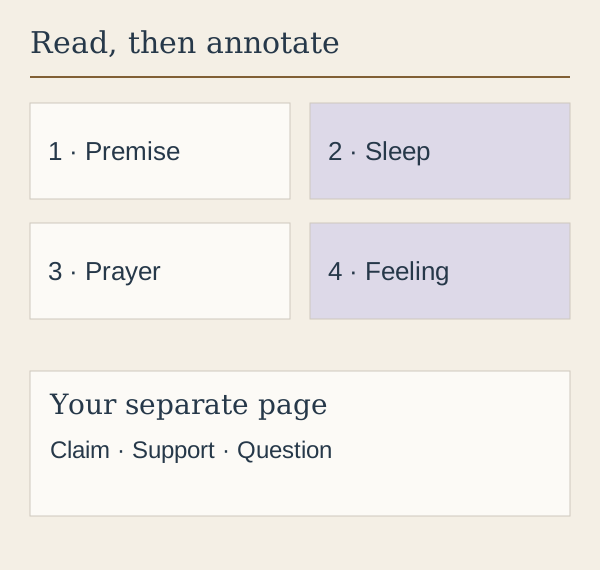
Set up a reading page
Have your edition open and note its publisher or transcription source. The version consulted here has four chapters. Some chapter headings vary across editions; use chapter numbers as well as names. Open the consulted transcription.
Give your notebook three headings: claim, support and question. This structure does not require you to decide immediately whether the author is right. It gives you a way to follow the argument without losing your own judgment.
A chapter-question grid
| Read | Notice | Write your question |
|---|---|---|
| Chapter 1 | The proposed conscious/subconscious relationship. | What connects the psychological description to the external causal claim? |
| Chapter 2 | The role assigned to sleep. | Is a proposed outcome supported here, or prescribed? |
| Chapter 3 | The account of prayer. | How does reception differ from asking in this passage? |
| Chapter 4 | The final return to feeling. | What does “feeling” mean in this particular sentence? |
This is a set of original reading prompts, not a chapter-by-chapter replacement for the text. Leave a cell unanswered until you have read the relevant passage.
Follow one inference rather than collecting slogans
A paragraph can move from an experience you recognize to an explanation you have not yet accepted. For example, noticing that expectations affect how you approach a conversation is different from concluding that expectations determine what the other person must say.
Mark the point where the argument changes scope. You might write: “I understand the description of an inner attitude. I still need an account of how that attitude is said to determine an external event.” That is a specific reading question. It is more useful than either endorsing or rejecting a short phrase without its surrounding reasoning.
A worked note about evidence
Here is an original sample note about the kind of argument a reader might encounter:
Claim type: an inward experience is assigned an outward effect.
Support I would look for: a clear description of the effect, alternatives considered and a comparison that could distinguish them.
My response: I may choose a reflective exercise while leaving the external causal claim unresolved.
This note does not purport to quote a passage or report a result. To evaluate a real passage, add its chapter and enough context to identify it. Our evidence guide explains why a personal sequence is not by itself a causal test.
Keep historical language in view
When the text uses gendered language for mental functions, record it as the author’s terminology. It is not a reason to assign people a fixed role by gender. Likewise, an author’s use of “subconscious” should not be treated as a complete modern account of cognition merely because the word is familiar.
A useful annotation has two parts: “This is how the text frames it” and “This is what I still need to investigate.” You do not have to resolve every historical assumption before reading the next paragraph, but neither do you have to import it into your own practice.
Choose one next reading, not a reading quota
If the word “feeling” remains unclear, use our three-part feeling distinction. If the larger account of consciousness is your question, move to the Power of Awareness workshop. If a term keeps changing meaning, make a card with the contextual glossary.
You can also stop with a question. A reading session that ends in a more precise uncertainty is not incomplete. Save your own note in the journal, keeping a short paraphrase separate from any exercise you choose to try.
Sources & reading notes
Sources consulted November 5, 2026. Original commentary; short paraphrases with attribution. No complete works are reproduced here.
- Neville Goddard, Feeling Is the Secret. Chapters 1–4; third-party transcription, compared by chapter heading. Archive rights claims are not a global license.