 Imagine Neville
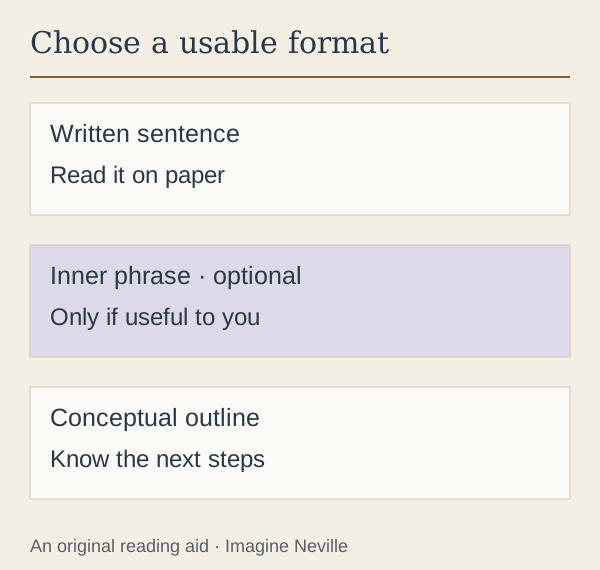
You can use this site’s reflection tools without producing a mental picture. Choose words, a conceptual outline or paper. We do not claim that these alternatives are equivalent tests of Neville’s metaphysics, diagnose aphantasia or train a missing ability.
Name the limited purpose
Neville’s Out of This World, chapter 1, discusses directed attention in a state akin to sleep and includes more than visual descriptions. Read the chapter.
Our optional adaptation asks a simpler question: can you describe your own participation and choose a next step? The SATS guide provides context; a written reflection can remain a written reflection without claiming a special state.
What imagery research adds — and does not add
Zeman, Dewar and Della Sala’s 2015 research letter describes people reporting a lifelong reduction or absence of voluntary visual imagery. The participants contacted the researchers themselves; this small, self-selected sample does not establish a population prevalence or test the success of a spiritual practice.
The relevant point here is modest: do not assume everyone describes the same internal experience when asked to visualize. Nor should a short website exercise become a diagnosis. This page offers no screening score or claim that it can change an imagery ability.
Route 1: write one plain sentence
Choose an ordinary task and describe the next part of your participation: “I open the draft and write the rough first line.” You can read the words on the screen or paper. There is no need to see a scene internally.
Then do the action if it is practical. For the Scene Builder, put that sentence in the scene field and leave sensory details blank. The tool’s use of the word “scene” does not require a picture.
Route 2: use an inner phrase, only if useful
If an inner verbal phrase is available and comfortable for you, choose one about your own conduct: “Ask the question, then listen.” It can function as a reminder rather than a prediction.
If you do not experience an inner voice, skip this route. Reading a phrase with your eyes or using a written list is sufficient for our exercise. Do not turn one alternative into another ability you must demonstrate. A sentence also need not produce a particular emotional tone; the feeling distinction separates those issues.
Route 3: outline a conceptual sequence
You may find it easier to know the order of a task than to simulate its sensory appearance. Make a three-item outline:
- Open the notes.
- Find the part I do not understand.
- Write one specific question.
No picture, imagined sound or bodily sensation is required. This is a planning-oriented adaptation, not evidence that our outline duplicates the process Neville describes. For an optional pause, you can use the silent timer while remaining comfortably awake, or simply leave the timer off.
Keep the outcome smaller than a metaphysical test
Afterward, record whether you tried the action and whether the format was useful, neutral or distracting. “The written prompt helped me begin” is a proportional personal observation. “This proves thoughts control events” is a larger claim it does not establish.
The scene workshop can help edit the words if the description is too long. Keep sleep and ordinary responsibilities in view. You do not owe the exercise a vivid image, a completed timer or a favorable result.
Sources & reading notes
Sources consulted November 5, 2026. Original commentary; short paraphrases with attribution. No complete works are reproduced here.
- Neville Goddard, Out of This World. Chapter 1, “Thinking Fourth-Dimensionally.” Third-party transcription.
- Zeman, Dewar & Della Sala (2015), Lives without imagery — Congenital aphantasia. Cortex 73, 378–380, DOI 10.1016/j.cortex.2015.05.019. University-hosted research letter; a small self-selected sample, not a population estimate or test of spiritual practice.