 Imagine Neville
Treat Neville’s terms as parts of an argument, not interchangeable slogans. This glossary gives you a short working meaning, a source location and a question that helps prevent one kind of claim from slipping into another.
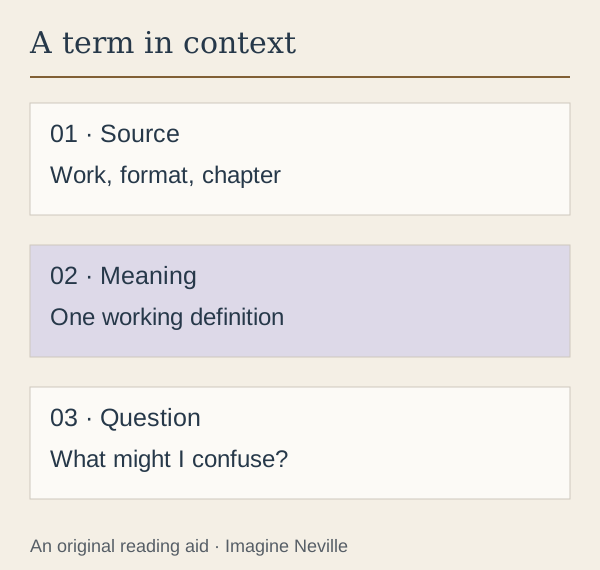
How to use a working definition
Find the term that interrupted your reading. Read its short definition, open the named source, then check whether that definition fits the actual paragraph. If it does not, make a note of the difference rather than forcing every occurrence into one formula.
The definitions below describe the author’s vocabulary. The reading questions and examples are ours. A definition of a spiritual claim does not establish that claim as fact.
Awareness, state and assumption
- I AM
- Awareness of being, before a particular self-description. Source: The Power of Awareness, chapter 1. Question: is the sentence about awareness itself or a belief added to it?
- State
- A condition or perspective occupied by the individual. Source: the opening of the 1953 Power of Awareness lecture. Question: is this a temporary perspective or an identity you are treating as permanent?
- Assumption
- Inward acceptance of a desired condition as fulfilled. Source: The Power of Awareness, chapter 3. Question: is this an imagined standpoint or an established external fact?
Book: chapters 1–3; lecture: opening pages. Our book-versus-lecture reading guide helps keep the two sources distinct.
Feeling and practice
- Feeling
- The author connects it with accepting the desired state. Source: Feeling Is the Secret, chapter 4. Question: does this occurrence mean emotion, sensation or conviction?
- SATS
- Current shorthand for a state akin to sleep. Source context: Out of This World, chapter 1. Question: are you reading the original description or a later routine?
- Revision
- Imaginative reworking of an unwanted episode. Source: Awakened Imagination, chapter 4. Question: have you kept the factual event separate from the imagined alternative?
Feeling, chapter 4; Out of This World, chapter 1; Awakened Imagination, chapter 4.
For a worked distinction between emotional tone, assumption and evidence, continue to feeling the wish fulfilled.
The Law and the Promise
The Law names the teaching’s account of imaginal causation. The Promise names a spiritual awakening Neville describes in a different register. Source: The Law and the Promise, chapters 1 and 15. Read the two chapters.
Do not use “promise” here as a guarantee that a particular request will be granted. The Promise reading guide offers a two-column note for keeping an outcome claim separate from a reported mystical experience.
A worked vocabulary note
Consider this original sample sentence: “I am learning to answer questions without rushing.” It includes several things that a slogan can blur.
- The awareness: there is a person noticing and describing an experience.
- The self-description: “learning” identifies a direction, rather than a completed qualification.
- The intended behavior: pausing before answering is something observable.
- The open result: no listener’s agreement has been guaranteed.
Now compare “My assumption caused the listener to agree.” That additional sentence introduces a causal claim. It does not follow merely because the first sentence was useful.
Make a four-line term card
- Write the work, format and chapter.
- Define the term in no more than one sentence.
- List one nearby term that it should not be confused with.
- Write the question you would need answered before accepting the larger claim.
For “feeling,” a useful nearby term might be “emotion.” For “revision,” it might be “memory.” For “assumption,” it might be “evidence.” The point is not to memorize our wording. It is to return to a passage with a more precise question.
Use the Reflection Journal for the card, or write it on paper. You do not need a new account, a special edition or agreement with the entire philosophy.
Sources & reading notes
Sources consulted November 5, 2026. Original commentary; short paraphrases with attribution. No complete works are reproduced here.
- Neville Goddard, The Power of Awareness. Chapters 1–3, 6, 21 and 23–24. Third-party book transcription; distinguish it from the 1953 lecture of the same name.
- Neville Goddard, The Power of Awareness (lecture, 1953). Lecture transcript, opening pages. This is not the book with the same title.
- Neville Goddard, Feeling Is the Secret. Chapters 1–4; third-party transcription, compared by chapter heading. Archive rights claims are not a global license.
- Neville Goddard, Out of This World. Chapter 1, “Thinking Fourth-Dimensionally.” Third-party transcription.
- Neville Goddard, Awakened Imagination. Chapters 1, 3 and 4, especially “The Pruning Shears of Revision.” Third-party transcription.
- Neville Goddard, The Law and the Promise. Chapter 1 and chapter 15, “The Promise.” Third-party transcription; personal accounts are not controlled evidence.