 Imagine Neville
For Neville, “the Promise” is humanity’s awakening as God, described through resurrection, birth from above and the revelation of divine fatherhood. He presents David as the son whose recognition reveals the individual as the Father, and gives this destiny universal scope. These are his theological claims, not this site’s guarantee of an experience or a granted wish.
Read the title as two subjects
The book’s chapter 1 presents imaginal causation; chapter 15 changes focus to reported mystical experiences and a spiritual account of birth from above. The author distinguishes using the Law from the purpose he assigns to the Promise. Read chapters 1 and 15.
Keep the distinction visible rather than treating the final chapter as one more checklist for obtaining an object. For Neville’s wider divine vocabulary, read his use of God and biblical language.
What the doctrine actually claims
In chapter 15, Neville describes God becoming human so that humanity may awaken as God. Resurrection and birth from above name this transformation in his account, rather than merely a better mood or a successful request.
He interprets an experience of David as his son as the revelation that he is the divine Father. He also presents the awakening as humanity’s destiny, not a privilege restricted to a few successful practitioners. Read chapter 15, including the David passage and conclusion.
That is why “the Promise” means more here than confidence in a desired outcome. The chapter makes a specific theological claim about human identity and purpose. A reader can accurately describe it before deciding whether to accept it.
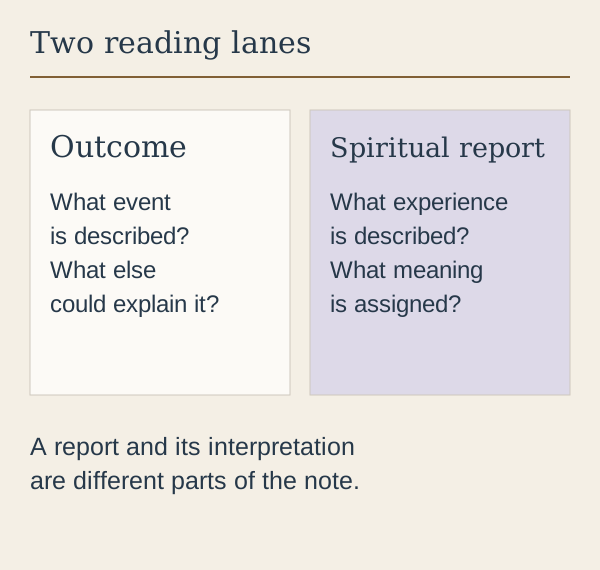
Two columns for two kinds of statement
| Outcome claim | Spiritual report or interpretation |
|---|---|
| A described desire and an event said to fulfill it. | A narrated experience assigned religious significance. |
| Ask what happened and what else could explain it. | Ask what is reported and how the author interprets it. |
| A personal account is not a controlled comparison. | A sincere experience does not automatically establish a universal theology. |
| Do not infer a guaranteed practical result. | Do not make an experience into a required milestone. |
These are our reading distinctions. They help you describe what a passage is doing before deciding what you believe about it.
Separate report from interpretation
A report might say that someone experienced a vivid dream, vision or sense of recognition. An interpretation might identify its significance within a religious story. The second statement adds a framework to the first.
In a reading note, give each a separate line. You do not have to decide that a report is fraudulent to question the interpretation. Conversely, finding an interpretation meaningful does not give you access to facts beyond what the account establishes.
Our argument-sheet workshop uses a similar distinction between a premise, an inference and an example.
A worked note without reproducing the narrative
Source: The Law and the Promise, chapter 15.
What I am tracking: the move from describing an experience to assigning it a theological meaning.
My question: which parts are accessible to another reader, and which depend on accepting the author’s framework?
Next reading: compare the terms used here with the earlier chapter, without assuming they perform the same job.
This is an original note template, not a quotation or a retelling of the chapter’s experiences. Reading the full chapter is still necessary to apply it.
Do not turn the chapter into a spiritual scoreboard
This site offers no test that certifies awakening, no timetable for having a particular experience and no rank for readers who report one. The notebook is not designed to induce unusual experiences. You do not need to disrupt sleep, intensify a practice or imitate someone else’s account to use it.
Reading can remain reading. If you do not share the author’s beliefs, you can still investigate how his vocabulary and argument change across a work. If you do share them, you can still make the distinction between your belief and a claim that everyone else must accept.
Questions to take back to the book
- What does the title lead me to expect before I read?
- Where does the subject or kind of evidence change?
- Which word carries a theological meaning I need to define?
- What am I adding to the account through my own interpretation?
- What remains a personal belief rather than an independently established fact?
The glossary offers a small reference card for the terms. The reading route helps you choose a next work without turning this chapter into a prerequisite or achievement.
Sources & reading notes
Sources consulted November 5, 2026. Original commentary; short paraphrases with attribution. No complete works are reproduced here.
- Neville Goddard, The Law and the Promise. Chapter 1 and chapter 15, “The Promise.” Third-party transcription; personal accounts are not controlled evidence.