 Imagine Neville
A useful revision note can keep four things separate: the event, your interpretation, an imagined alternative and a real next action. These examples show our bounded adaptation. They do not claim that imagining changes records, memories or other people’s choices.
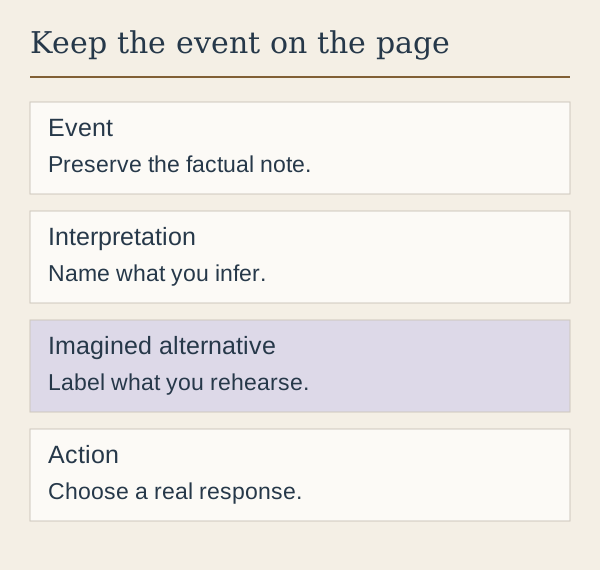
Use the historical idea with a clear limit
Awakened Imagination, chapter 4, describes imaginatively reworking episodes. Read the source chapter.
For our adaptation, keep the original factual note. Choose an ordinary event you can consider without becoming overwhelmed. You do not need to revisit trauma. The revision guide explains why this is a reflection exercise rather than a way to erase what happened.
Example 1: an email sent too quickly
Observation: “I sent a draft before attaching the document. The recipient asked for it.”
Interpretation: “I worried that I seemed careless. I do not know what the recipient concluded.”
Imagined alternative: “I pause, check the attachment line and open the attached file before sending.”
Next action: “Send the document with a brief acknowledgment, then use an attachment check next time.”
The alternative is a rehearsal for your conduct. The actual email remains in the record. The useful repair is sending the missing document, not privately assuming the recipient received something they did not.
Example 2: an unclear commitment
Observation: “I agreed to help on Saturday without asking how long the task would take.”
Interpretation: “I now suspect I cannot finish it in the time available. That is a planning concern, not proof that the other person intended to take advantage.”
Imagined alternative: “I ask what needs to be done and say how much time I can offer.”
Next action: “Clarify the scope and my availability before Saturday. Accept that we may need a different arrangement.”
This note does not guarantee the other person will welcome the clarification. It helps identify the conversation you actually need.
Example 3: someone declined an invitation
Observation: “They said they would not like to meet.”
Interpretation: “I feel disappointed. I do not need to invent an explanation for their answer.”
Imagined alternative: “I hear myself acknowledge the answer and turn to a plan I can choose independently.”
Next action: “Respect the refusal. Make another plan without pressuring them.”
The target of the rehearsal is your response, not reversing their decision. The consent guide explains this boundary. Do not transform a direct refusal into a hidden agreement because you prefer a different story.
Fit four parts into the existing journal
The Reflection Journal has three fields. Use them without blurring their purpose:
- What I observed: the factual event and anything uncertain.
- How I interpret it: your interpretation, then a new line explicitly labeled “Imagined alternative.”
- My next action: a practical response, or “No follow-up needed” if that is your considered choice.
Add a later dated entry for the actual follow-up. Do not silently change the original observation so it appears to have predicted the outcome. Editing a typo is different from replacing the record with what you wish had happened.
A blank template to keep
Event I can describe:
What I do not know:
My interpretation:
Imagined alternative — my own response:
One real next action:
Later observation, recorded separately:
To shorten an imagined alternative, use the scene-editing checklist. Stop when you have a usable response; a complete review of the day is not required. If the exercise is only extending rumination, leaving the page alone is an available choice.
Sources & reading notes
Sources consulted November 5, 2026. Original commentary; short paraphrases with attribution. No complete works are reproduced here.
- Neville Goddard, Awakened Imagination. Chapters 1, 3 and 4, especially “The Pruning Shears of Revision.” Third-party transcription.